🇲🇭 Marshall Islands
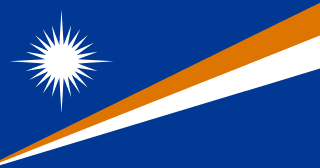 National Flag
Geography & Borders
This country has no land borders.
Introduction & Background
The Marshall Islands (Template:Lang-mh),9 officially the Republic of the Marshall Islands (Template:Lang-mh),note 1 is an independent island country and microstate near the Equator in the Pacific Ocean, slightly west of the International Date Line. Geographically, the country is part of the larger island group of Micronesia. The country's population of 58,413 people (at the 2018 World Bank Census10) is spread out over five islands and 29 coral atolls,2 comprising 1,156 individual islands and islets. The capital and largest city is Majuro. It has the largest portion of its territory composed of water of any sovereign state, at 97.87%. The islands share maritime boundaries with Wake Island to the north,note 2 Kiribati to the southeast, Nauru to the south, and Federated States of Micronesia to the west. About 52.3% of Marshall Islanders (27,797 at the 2011 Census) live on Majuro.2 In 2016, 73.3% of the population were defined as being "urban". The UN also indicates a population density of 760 inhabitants per square mile (295/km2), and its projected 2020 population is 59,190.11
Micronesian settlers reached the Marshall Islands using canoes circa 2nd millennium BC, with interisland navigation made possible using traditional stick charts. They eventually settled there.12 Islands in the archipelago were first explored by Europeans in the 1520s, starting with Ferdinand Magellan, a Portuguese explorer in the service of Spain, Juan Sebastián Elcano and Miguel de Saavedra. Spanish explorer Alonso de Salazar reported sighting an atoll in August 1526.12 Other expeditions by Spanish and English ships followed. The islands derive their name from John Marshall, who visited in 1788. The islands were historically known by the inhabitants as "jolet jen Anij" (Gifts from God).13 Spain claimed the islands in 1592, and the European powers recognized its sovereignty over the islands in 1874. They had been part of the Spanish East Indies formally since 1528. Later, Spain sold some of the islands to the German Empire in 1885, and they became part of German New Guinea that year, run by the trading companies doing business in the islands, particularly the Jaluit Company.12 In World War I, the Empire of Japan occupied the Marshall Islands, which, in 1920, the League of Nations combined with other former German territories to form the South Seas Mandate. During World War II, the United States took control of the islands in the Gilbert and Marshall Islands campaign in 1944. Nuclear testing began on Bikini Atoll in 1946 and concluded in 1958.
Minerals
No mineral species have their type localities (original discovery site) defined within Marshall Islands in the Wikidata database. Explore other galleries to view geographic and climate data.
Flora & Flowers
Marshall Islands is home to a diverse range of plant species. Explore some of the native plants and flowers found in Marshall Islands below:
Loading plant species...
Animals & Wildlife
Marshall Islands is home to a diverse range of animal species. Explore some of the native animals and wildlife found in Marshall Islands below:
Loading animal species...
Music Albums
Explore the top 30 most-played music albums in Marshall Islands, sourced from Apple Music charts:
Loading music charts…