Land
Home
Continents
  • All Galleries
  • Elevation Maps
  • Minerals
  • Flora & Flowers
  • Animals & Wildlife
  • Climate Change
  • Music Albums
Home
Continents
  • All Galleries
  • Elevation Maps
  • Minerals
  • Flora & Flowers
  • Animals & Wildlife
  • Climate Change
  • Music Albums
  • South America

    • South America
    • South America Elevation
    • South America Minerals
    • South America Flora & Flowers
    • South America Animals & Wildlife
    • South America Music Albums
    • South America Climate Change
    • Argentina
    • Bolivia
    • Brazil
    • Chile
    • Colombia
    • Ecuador
    • Falkland Islands
    • French Guiana
    • Guyana
    • Paraguay
    • Peru
    • Suriname
    • Uruguay
    • Venezuela
  • All Continents

🇦🇷 Argentina

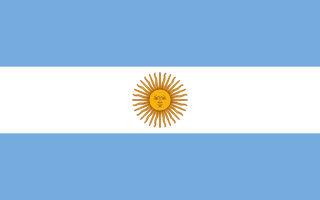
Flag of ArgentinaNational Flag

Geography & Borders

BoliviaBoliviaBrazilBrazilChileChileParaguayParaguayUruguayUruguay

Introduction & Background

Argentina (Template:IPA-es), officially the Argentine RepublicA (Template:Lang-es), is a country in the southern half of South America. Argentina covers an area of 2,780,400km2 (1,073,500mi2),B making it the second-largest country in South America after Brazil, the fourth-largest country in the Americas, and the eighth-largest country in the world. It shares the bulk of the Southern Cone with Chile to the west, and is also bordered by Bolivia and Paraguay to the north, Brazil to the northeast, Uruguay and the South Atlantic Ocean to the east, and the Drake Passage to the south. Argentina is a federal state subdivided into twenty-three provinces, and one autonomous city, which is the federal capital and largest city of the nation, Buenos Aires. The provinces and the capital have their own constitutions, but exist under a federal system. Argentina claims sovereignty over the Falkland Islands, South Georgia and the South Sandwich Islands, and a part of Antarctica.

The earliest recorded human presence in modern-day Argentina dates back to the Paleolithic period.13 The Inca Empire expanded to the northwest of the country in Pre-Columbian times. The country has its roots in Spanish colonization of the region during the 16th century.14 Argentina rose as the successor state of the Viceroyalty of the Río de la Plata,15 a Spanish overseas viceroyalty founded in 1776. The declaration and fight for independence (1810–1818) was followed by an extended civil war that lasted until 1861, culminating in the country's reorganization as a federation. The country thereafter enjoyed relative peace and stability, with several waves of European immigration, mainly Italians and Spaniards, radically reshaping its cultural and demographic outlook; over 60% of the population has full or partial Italian ancestry,161718 and Argentine culture has significant connections to Italian culture.19

Overview
AttributeDetails
Official Name
Argentine Republic
Capital
Buenos Aires
Continent
South America
Region / Subregion
Americas / South America
Population
46,735,004
Area
2,780,400 km²
Languages
Guaraní, Spanish
Currencies
Argentine peso ($) [ARS]
Cost of Living
38.6 / 100 (Moderate)
Price per Coffee
$1.93
Price per Meal
$9.38
Timezones
UTC-03:00 (ART), UTC-03:00 (ART), UTC-03:00 (ART), UTC-03:00 (ART), UTC-03:00 (ART), UTC-03:00 (ART), UTC-03:00 (ART), UTC-03:00 (ART), UTC-03:00 (ART), UTC-03:00 (ART), UTC-03:00 (ART), UTC-03:00 (ART)
Bounding Box
Min: (55.25° S, 73.42° W)
Max: (21.83° S, 53.63° W)
Climate
Temperate
Terrain
Diverse, featuring the Andes mountains in the west, Amazon basin in the north-central, and plains in the south
GDP (Nominal)
$638.37 billion (2024)
GDP (PPP)
$1.39 trillion (2024)
GDP Growth Rate
-1.34% (2024)
Macroeconomic Overview
The economy of Argentina is South America's second-largest, behind Brazil. The United Nations' Human Development Index ranks Argentina "very high," reflecting a literate population, export-oriented agriculture, and diversified industry. Rich natural resources underpin the economy, although performance has been volatile – growth spurts alternate with recessions—especially since the late 20th century—driving income inequality and poverty. Early in that century, Argentina's per capita GDP ranked among the global top ten, matching Canada and Australia while exceeding France and Italy. The Argentine peso lost ~50% of its value in 2018 because of hyperinflation, prompting an IMF stand-by program. It fell another 25% in 2019, 90% in 2020, 68% in 2021, and 50% in 2022, 54% in 2023, 30% in 2024, before rising in 2025. The FTSE Global Equity Index (2018) listed Argentina as an emerging market and G20 member. Prolonged capital controls led MSCI to reclassify it as a standalone market in 2021.

Geography & Climate


  • Map Locations: Google Maps | OpenStreetMap

Minerals

Argentina is the type locality (the site where the mineral was first discovered and described) for 27 recognized mineral species. Explore these discoveries below:

Loading mineral discoveries...

Flora & Flowers

Argentina is home to a diverse range of plant species. Explore some of the native plants and flowers found in Argentina below:

Loading plant species...

Animals & Wildlife

Argentina is home to a diverse range of animal species. Explore some of the native animals and wildlife found in Argentina below:

Loading animal species...

Music Albums

Explore the top 30 most-played music albums in Argentina, sourced from Apple Music charts:

Loading music charts…


← Back to South America

Prev
South America Climate Change
Next
Bolivia