🇨🇴 Colombia
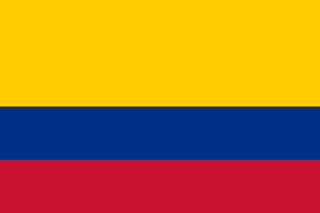 National Flag
Geography & Borders


Introduction & Background
Colombia (/kəˈlʌmbiə/ⓘ, /-ˈlɒm-/;12 Template:IPA-es), officially the Republic of Colombia,a is a country in South America with insular regions in North America—near Nicaragua's Caribbean coast—as well as in the Pacific Ocean. The Colombian mainland is bordered by the Caribbean Sea to the north, Venezuela to the east and northeast, Brazil to the southeast, Ecuador and Peru to the south and southwest, the Pacific Ocean to the west, and Panama to the northwest. Colombia is divided into 32 departments and the Capital District of Bogotá, the country's largest city. It covers an area of 1,141,748 square kilometers (440,831 sq mi), and has a population of 52 million. Colombia's cultural heritage—including language, religion, cuisine, and art—reflects its history as a Spanish colony, fusing cultural elements brought by immigration from Europe and the Middle East, with those brought by enslaved Africans, as well as with those of the various Indigenous civilizations that predate colonization. Spanish is the official state language, although English and 64 other languages are recognized regional languages.
Colombia has been home to many indigenous peoples and cultures since at least 12,000 BCE. The Spanish first landed in La Guajira in 1499, and by the mid-16th century they had explored and colonized much of present-day Colombia, and established the New Kingdom of Granada, with Santa Fé de Bogotá as its capital. Independence from the Spanish Empire was achieved in 1819, with what is now Colombia emerging as the United Provinces of New Granada. The new polity experimented with federalism as the Granadine Confederation (1858) and then the United States of Colombia (1863), before becoming a republic—the current Republic of Colombia—in 1886. With the backing of the United States and France, Panama seceded from Colombia in 1903, resulting in Colombia's present borders. Beginning in the 1960s, the country has suffered from an asymmetric low-intensity armed conflict and political violence, both of which escalated in the 1990s. Since 2005, there has been significant improvement in security, stability and rule of law, as well as unprecedented economic growth and development.1314
Minerals
No mineral species have their type localities (original discovery site) defined within Colombia in the Wikidata database. Explore other galleries to view geographic and climate data.
Flora & Flowers
Colombia is home to a diverse range of plant species. Explore some of the native plants and flowers found in Colombia below:
Loading plant species...
Animals & Wildlife
Colombia is home to a diverse range of animal species. Explore some of the native animals and wildlife found in Colombia below:
Loading animal species...
Music Albums
Explore the top 30 most-played music albums in Colombia, sourced from Apple Music charts:
Loading music charts…