🇳🇵 Nepal
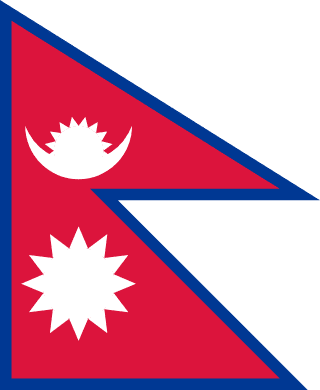 National Flag
Geography & Borders


Introduction & Background
Nepal (English: /nɪˈpɔːl/;14 Template:Lang-ne Template:IPA-ne), officially the Federal Democratic Republic of Nepal (Template:Lang-ne),15 is a landlocked country in South Asia. It is mainly situated in the Himalayas, but also includes parts of the Indo-Gangetic Plain, bordering the Tibet Autonomous Region of China to the north, and India in the south, east, and west, while it is narrowly separated from Bangladesh by the Siliguri Corridor, and from Bhutan by the Indian state of Sikkim. Nepal has a diverse geography, including fertile plains, subalpine forested hills, and eight of the world's ten tallest mountains, including Mount Everest, the highest point on Earth. Nepal is a multi-ethnic, multi-lingual, multi-religious and multi-cultural state, with Nepali as the official language. Kathmandu is the nation's capital and the largest city.
The name "Nepal" is first recorded in texts from the Vedic period of the Indian subcontinent, the era in ancient Nepal when Hinduism was founded, the predominant religion of the country. In the middle of the first millennium BC, Gautama Buddha, the founder of Buddhism, was born in Lumbini in southern Nepal. Parts of northern Nepal were intertwined with the culture of Tibet. The centrally located Kathmandu Valley is intertwined with the culture of Indo-Aryans, and was the seat of the prosperous Newar confederacy known as Nepal Mandala. The Himalayan branch of the ancient Silk Road was dominated by the valley's traders. The cosmopolitan region developed distinct traditional art and architecture. By the 18th century, the Gorkha Kingdom achieved the unification of Nepal. The Shah dynasty established the Kingdom of Nepal and later formed an alliance with the British Empire, under its Rana dynasty of premiers. The country was never colonised but served as a buffer state between Imperial China and British India. Parliamentary democracy was introduced in 1951 but was twice suspended by Nepalese monarchs, in 1960 and 2005. The Nepalese Civil War in the 1990s and early 2000s resulted in the establishment of a secular republic in 2008, ending the world's last Hindu monarchy.
Minerals
No mineral species have their type localities (original discovery site) defined within Nepal in the Wikidata database. Explore other galleries to view geographic and climate data.
Flora & Flowers
Nepal is home to a diverse range of plant species. Explore some of the native plants and flowers found in Nepal below:
Loading plant species...
Animals & Wildlife
Nepal is home to a diverse range of animal species. Explore some of the native animals and wildlife found in Nepal below:
Loading animal species...
Music Albums
Explore the top 30 most-played music albums in Nepal, sourced from Apple Music charts:
Loading music charts…