Land
Home
Continents
  • All Galleries
  • Elevation Maps
  • Minerals
  • Flora & Flowers
  • Animals & Wildlife
  • Climate Change
  • Music Albums
Home
Continents
  • All Galleries
  • Elevation Maps
  • Minerals
  • Flora & Flowers
  • Animals & Wildlife
  • Climate Change
  • Music Albums
  • North America

    • North America
    • North America Elevation
    • North America Minerals
    • North America Flora & Flowers
    • North America Animals & Wildlife
    • North America Music Albums
    • North America Climate Change
    • Anguilla
    • Antigua and Barbuda
    • Aruba
    • Bahamas
    • Barbados
    • Belize
    • Bermuda
    • British Virgin Islands
    • Canada
    • Caribbean Netherlands
    • Cayman Islands
    • Costa Rica
    • Cuba
    • Curaçao
    • Dominica
    • Dominican Republic
    • El Salvador
    • Greenland
    • Grenada
    • Guadeloupe
    • Guatemala
    • Haiti
    • Honduras
    • Jamaica
    • Martinique
    • Mexico
    • Montserrat
    • Nicaragua
    • Panama
    • Puerto Rico
    • Saint Barthélemy
    • Saint Kitts and Nevis
    • Saint Lucia
    • Saint Martin
    • Saint Pierre and Miquelon
    • Saint Vincent and the Grenadines
    • Sint Maarten
    • Trinidad and Tobago
    • Turks and Caicos Islands
    • United States
    • United States Minor Outlying Islands
    • United States Virgin Islands
  • All Continents

🇦🇬 Antigua and Barbuda
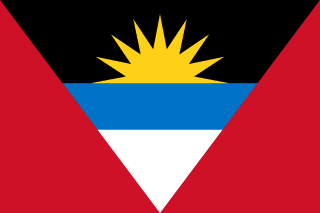
Flag of Antigua and BarbudaNational Flag
🎵 National Anthem
Your browser does not support the audio element.

Geography & Borders

This country has no land borders.

Introduction & Background

Antigua and Barbuda (UK: /ænˈtiːɡə...bɑːrˈbuːdə/, US: /ænˈtiːɡwə...bɑːrˈbjuːdə/) is a sovereign country in the West Indies. It lies at the juncture of the Caribbean Sea and the Atlantic Ocean in the Leeward Islands part of the Lesser Antilles, at 17°N latitude. The country consists of two major islands, Antigua and Barbuda, approximately 40km (20mi) apart, and several smaller islands, including Great Bird, Green, Guiana, Long, Maiden, Prickly Pear, York, and Redonda. The permanent population is approximately 97,120 (2019update est.), 97% residing in Antigua.1 St. John's, Antigua, is the country's capital, major city, and largest port. Codrington is Barbuda's largest town.

In 1493, Christopher Columbus reconnoitred the island of Antigua, which he named for the Church of Santa María La Antigua.12 Great Britain colonized Antigua in 1632 and Barbuda in 1678.12 A part of the Federal Colony of the Leeward Islands from 1871, Antigua and Barbuda joined the West Indies Federation in 1958.13 With the breakup of the federation in 1962, it became one of the West Indies Associated States in 1967.14 Following a period of internal self-governance, it gained full independence from the United Kingdom on 1 November 1981. Antigua and Barbuda is a member of the Commonwealth and a Commonwealth realm; it is a constitutional monarchy with Charles III as its head of state.15

Overview
AttributeDetails
Official Name
Antigua and Barbuda
Capital
Saint John's
Continent
North America
Region / Subregion
Americas / Caribbean
Population
103,603
Area
442 km²
Languages
English
Currencies
Eastern Caribbean dollar ($) [XCD]
Cost of Living
55 / 100 (Moderate)
Price per Coffee
$2.75
Price per Meal
$12.50
Timezones
UTC-04:00 (AST)
Bounding Box
Min: (16.954933365702477° N, 61.898770596475224° W)
Max: (17.145066634297525° N, 61.70122940352477° W)
Climate
Tropical / Warm
Terrain
low-lying limestone and coral islands, with some higher volcanic areas
GDP (Nominal)
$2.21 billion (2024)
GDP (PPP)
$3.13 billion (2024)
GDP Growth Rate
3.66% (2024)
Macroeconomic Overview
The economy of Antigua and Barbuda is service-based, with tourism and government services representing the key sources of employment and income. Tourism accounts directly or indirectly for more than half of GDP and is also the principal earner of foreign exchange in Antigua and Barbuda. However, a series of violent hurricanes since 1995 resulted in serious damage to tourist infrastructure and periods of sharp reductions in visitor numbers. In 1999 the budding offshore financial sector was seriously hurt by financial sanctions imposed by the United States and United Kingdom as a result of the loosening of its money-laundering controls. The government has made efforts to comply with international demands in order to get the sanctions lifted. The dual island nation's agricultural production is mainly directed to the domestic market; the sector is constrained by the limited water supply and labor shortages that reflect the pull of higher wages in tourism and construction. Manufacturing comprises enclave-type assembly for export with major products being bedding, handicrafts, and electronic components. Prospects for economic growth in the medium term will continue to depend on income growth in the industrialized world, especially in the US, which accounts for about one-third of all tourist arrivals. Estimated overall economic growth for 2000 was 2.5%. Inflation has trended down going from above 2 percent in the 1995-99 period and estimated at 0 percent in 2000.

Geography & Climate


  • Map Locations: Google Maps | OpenStreetMap

Minerals

No mineral species have their type localities (original discovery site) defined within Antigua and Barbuda in the Wikidata database. Explore other galleries to view geographic and climate data.

Flora & Flowers

Antigua and Barbuda is home to a diverse range of plant species. Explore some of the native plants and flowers found in Antigua and Barbuda below:

Loading plant species...

Animals & Wildlife

Antigua and Barbuda is home to a diverse range of animal species. Explore some of the native animals and wildlife found in Antigua and Barbuda below:

Loading animal species...

Music Albums

Explore the top 30 most-played music albums in Antigua and Barbuda, sourced from Apple Music charts:

Loading music charts…


← Back to North America

Prev
Anguilla
Next
Aruba