Land
Home
Continents
  • All Galleries
  • Elevation Maps
  • Minerals
  • Flora & Flowers
  • Animals & Wildlife
  • Climate Change
  • Music Albums
Home
Continents
  • All Galleries
  • Elevation Maps
  • Minerals
  • Flora & Flowers
  • Animals & Wildlife
  • Climate Change
  • Music Albums
  • North America

    • North America
    • North America Elevation
    • North America Minerals
    • North America Flora & Flowers
    • North America Animals & Wildlife
    • North America Music Albums
    • North America Climate Change
    • Anguilla
    • Antigua and Barbuda
    • Aruba
    • Bahamas
    • Barbados
    • Belize
    • Bermuda
    • British Virgin Islands
    • Canada
    • Caribbean Netherlands
    • Cayman Islands
    • Costa Rica
    • Cuba
    • Curaçao
    • Dominica
    • Dominican Republic
    • El Salvador
    • Greenland
    • Grenada
    • Guadeloupe
    • Guatemala
    • Haiti
    • Honduras
    • Jamaica
    • Martinique
    • Mexico
    • Montserrat
    • Nicaragua
    • Panama
    • Puerto Rico
    • Saint Barthélemy
    • Saint Kitts and Nevis
    • Saint Lucia
    • Saint Martin
    • Saint Pierre and Miquelon
    • Saint Vincent and the Grenadines
    • Sint Maarten
    • Trinidad and Tobago
    • Turks and Caicos Islands
    • United States
    • United States Minor Outlying Islands
    • United States Virgin Islands
  • All Continents

🇳🇮 Nicaragua

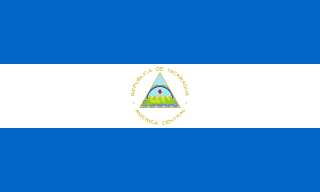
Flag of NicaraguaNational Flag

Geography & Borders

Costa RicaCosta RicaHondurasHonduras

Introduction & Background

Nicaragua (/ˌnɪkəˈrɑːɡwə, -ˈræɡ-, -ɡjuə/ⓘ; Template:IPA-es), officially the Republic of Nicaragua (Template:Audio-es), is the largest country in Central America, bordered by Honduras to the north, the Caribbean to the east, Costa Rica to the south, and the Pacific Ocean to the west. Managua is the country's capital and largest city. As of 2015update, it was estimated to be the second largest city in Central America. Nicaragua's multiethnic population of six million includes people of mestizo, indigenous, European and African heritage. The main language is Spanish. Indigenous tribes on the Mosquito Coast speak their own languages and English.

Originally inhabited by various indigenous cultures since ancient times, the region was conquered by the Spanish Empire in the 16th century. Nicaragua gained independence from Spain in 1821. The Mosquito Coast followed a different historical path, being colonized by the English in the 17th century and later coming under British rule. It became an autonomous territory of Nicaragua in 1860 and its northernmost part was transferred to Honduras in 1960. Since its independence, Nicaragua has undergone periods of political unrest, dictatorship, occupation and fiscal crisis, including the Nicaraguan Revolution of the 1960s and 1970s and the Contra War of the 1980s.

Overview
AttributeDetails
Official Name
Republic of Nicaragua
Capital
Managua
Continent
North America
Region / Subregion
Americas / Central America
Population
6,803,886
Area
130,373 km²
Languages
Spanish
Currencies
Nicaraguan córdoba (C$) [NIO]
Cost of Living
35 / 100 (Moderate)
Price per Coffee
$1.75
Price per Meal
$7.50
Timezones
UTC-06:00 (CST)
Bounding Box
Min: (10.73° N, 87.67° W)
Max: (15.02° N, 83.15° W)
Climate
Tropical / Warm
Terrain
Rugged mountains, hills, fertile valleys, and coastal lowlands
GDP (Nominal)
$19.69 billion (2024)
GDP (PPP)
$60.23 billion (2024)
GDP Growth Rate
3.59% (2024)
Macroeconomic Overview
The economy of Nicaragua is focused primarily on the agricultural sector. Even so, Nicaragua itself is the least developed country in Central America, and the second least developed in the Americas by nominal GDP, behind only Haiti. In recent years, under the administrations of Daniel Ortega, the Nicaraguan economy has expanded somewhat, following the Great Recession, when the country's economy actually contracted by 1.5%, due to decreased export demand in the American and Central American markets, lower commodity prices for key agricultural exports, and low remittance growth. The economy saw 4.5% growth in 2010 thanks to a recovery in export demand and growth in its tourism industry. Nicaragua's economy continues to post growth, with preliminary indicators showing the Nicaraguan economy growing an additional 5% in 2011. Consumer Price inflation have also curtailed since 2008, when Nicaragua's inflation rate hovered at 19.82%. In 2009 and 2010, the country posted lower inflation rates, 3.68% and 5.45%, respectively. Remittances are a major source of income, equivalent to 15% of the country's GDP, which originate primarily from Costa Rica, the United States, and European Union member states. Approximately one million Nicaraguans contribute to the remittance sector of the economy.

Geography & Climate


  • Map Locations: Google Maps | OpenStreetMap

Minerals

No mineral species have their type localities (original discovery site) defined within Nicaragua in the Wikidata database. Explore other galleries to view geographic and climate data.

Flora & Flowers

Nicaragua is home to a diverse range of plant species. Explore some of the native plants and flowers found in Nicaragua below:

Loading plant species...

Animals & Wildlife

Nicaragua is home to a diverse range of animal species. Explore some of the native animals and wildlife found in Nicaragua below:

Loading animal species...

Music Albums

Explore the top 30 most-played music albums in Nicaragua, sourced from Apple Music charts:

Loading music charts…


← Back to North America

Prev
Montserrat
Next
Panama