Land
Home
Continents
  • All Galleries
  • Elevation Maps
  • Minerals
  • Flora & Flowers
  • Animals & Wildlife
  • Climate Change
  • Music Albums
Home
Continents
  • All Galleries
  • Elevation Maps
  • Minerals
  • Flora & Flowers
  • Animals & Wildlife
  • Climate Change
  • Music Albums
  • Europe

    • Europe
    • Europe Elevation
    • Europe Minerals
    • Europe Flora & Flowers
    • Europe Animals & Wildlife
    • Europe Music Albums
    • Europe Climate Change
    • Åland Islands
    • Albania
    • Andorra
    • Austria
    • Belarus
    • Belgium
    • Bosnia and Herzegovina
    • Bulgaria
    • Croatia
    • Cyprus
    • Czechia
    • Denmark
    • Estonia
    • Faroe Islands
    • Finland
    • France
    • Germany
    • Gibraltar
    • Greece
    • Guernsey
    • Hungary
    • Iceland
    • Ireland
    • Isle of Man
    • Italy
    • Jersey
    • Kosovo
    • Latvia
    • Liechtenstein
    • Lithuania
    • Luxembourg
    • Malta
    • Moldova
    • Monaco
    • Montenegro
    • Netherlands
    • North Macedonia
    • Norway
    • Poland
    • Portugal
    • Romania
    • Russia
    • San Marino
    • Serbia
    • Slovakia
    • Slovenia
    • Spain
    • Svalbard and Jan Mayen
    • Sweden
    • Switzerland
    • Ukraine
    • United Kingdom
    • Vatican City
  • All Continents

🇭🇷 Croatia

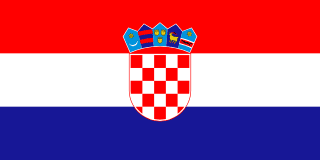
Flag of CroatiaNational Flag

Geography & Borders

Bosnia and HerzegovinaBosnia and HerzegovinaHungaryHungaryMontenegroMontenegroSerbiaSerbiaSloveniaSlovenia

Introduction & Background

Croatia (/kroʊˈeɪʃə/ⓘ, kroh-AY-shə; Template:Lang-hr, Template:IPA-hr), officially the Republic of Croatia (Template:Lang-hr, (listenⓘ)),e is a country at the crossroads of Central and Southeast Europe. Its sole coast is on the Adriatic Sea. It borders Slovenia to the northwest, Hungary to the northeast, Serbia to the east, Bosnia and Herzegovina and Montenegro to the southeast, and shares a maritime border with Italy to the west and southwest. Its capital and largest city, Zagreb, forms one of the country's primary subdivisions, with twenty counties. The country spans 56,594 square kilometres (21,851 square miles), and has a population of nearly 3.9million.

The Croats arrived in the late 6th century. By the 9th century, they had organized the territory into two duchies. Croatia was first internationally recognized as independent on 7 June 879 during the reign of Duke Branimir. Tomislav became the first king by 925, elevating Croatia to the status of a kingdom. During the succession crisis after the Trpimirović dynasty ended, Croatia entered a personal union with Hungary in 1102. In 1527, faced with Ottoman conquest, the Croatian Parliament elected Ferdinand I of Austria to the Croatian throne. In October 1918, the State of Slovenes, Croats and Serbs, independent from Austria-Hungary, was proclaimed in Zagreb, and in December 1918, merged into the Kingdom of Yugoslavia. Following the Axis invasion of Yugoslavia in April 1941, most of Croatia was incorporated into a Nazi-installed puppet state, the Independent State of Croatia. A resistance movement led to the creation of the Socialist Republic of Croatia, which after the war became a founding member and constituent of the Socialist Federal Republic of Yugoslavia. On 25 June 1991, Croatia declared independence, and the War of Independence was successfully fought over the next four years.

Overview
AttributeDetails
Official Name
Republic of Croatia
Capital
Zagreb
Continent
Europe
Region / Subregion
Europe / Southeast Europe
Population
3,866,233
Area
56,594 km²
Languages
Croatian
Currencies
Euro (€) [EUR]
Cost of Living
50.9 / 100 (Moderate)
Price per Coffee
$2.54
Price per Meal
$10.68
Timezones
UTC+01:00 (CET)
Bounding Box
Min: (42.48° N, 13.66° E)
Max: (46.5° N, 19.39° E)
Climate
Temperate
Terrain
Mostly plains and low plateaus, with mountains on the southern and western borders
GDP (Nominal)
$92.98 billion (2024)
GDP (PPP)
$191.57 billion (2024)
GDP Growth Rate
3.83% (2024)
Macroeconomic Overview
Croatia has a highly developed mixed economy. It is one of the largest economies in Southeast Europe by nominal gross domestic product (GDP). It maintains a similarly high regional GDP-per-capita. It is an open economy with accommodative foreign policy, highly dependent on international trade in Europe. Within Croatia, economic development varies among its counties, with strongest growth in Central Croatia and its financial centre, Zagreb. It has a very high level of human development, low levels of income inequality, and a high quality of life. Croatia's labor market has been perennially inefficient, with an underdeveloped investment climate and an ineffective corporate and income tax system.

Geography & Climate


  • Map Locations: Google Maps | OpenStreetMap

Minerals

No mineral species have their type localities (original discovery site) defined within Croatia in the Wikidata database. Explore other galleries to view geographic and climate data.

Flora & Flowers

Croatia is home to a diverse range of plant species. Explore some of the native plants and flowers found in Croatia below:

Loading plant species...

Animals & Wildlife

Croatia is home to a diverse range of animal species. Explore some of the native animals and wildlife found in Croatia below:

Loading animal species...

Music Albums

Explore the top 30 most-played music albums in Croatia, sourced from Apple Music charts:

Loading music charts…


← Back to Europe

Prev
Bulgaria
Next
Cyprus