Land
Home
Continents
  • All Galleries
  • Elevation Maps
  • Minerals
  • Flora & Flowers
  • Animals & Wildlife
  • Climate Change
  • Music Albums
Home
Continents
  • All Galleries
  • Elevation Maps
  • Minerals
  • Flora & Flowers
  • Animals & Wildlife
  • Climate Change
  • Music Albums
  • Africa

    • Africa
    • Africa Elevation
    • Africa Minerals
    • Africa Flora & Flowers
    • Africa Animals & Wildlife
    • Africa Music Albums
    • Africa Climate Change
    • Algeria
    • Angola
    • Benin
    • Botswana
    • British Indian Ocean Territory
    • Burkina Faso
    • Burundi
    • Cameroon
    • Cape Verde
    • Central African Republic
    • Chad
    • Comoros
    • Congo
    • Djibouti
    • DR Congo
    • Egypt
    • Equatorial Guinea
    • Eritrea
    • Eswatini
    • Ethiopia
    • Gabon
    • Gambia
    • Ghana
    • Guinea
    • Guinea-Bissau
    • Ivory Coast
    • Kenya
    • Lesotho
    • Liberia
    • Libya
    • Madagascar
    • Malawi
    • Mali
    • Mauritania
    • Mauritius
    • Mayotte
    • Morocco
    • Mozambique
    • Namibia
    • Niger
    • Nigeria
    • Réunion
    • Rwanda
    • Saint Helena, Ascension and Tristan da Cunha
    • São Tomé and Príncipe
    • Senegal
    • Seychelles
    • Sierra Leone
    • Somalia
    • South Africa
    • South Sudan
    • Sudan
    • Tanzania
    • Togo
    • Tunisia
    • Uganda
    • Western Sahara
    • Zambia
    • Zimbabwe
  • All Continents

🇦🇴 Angola

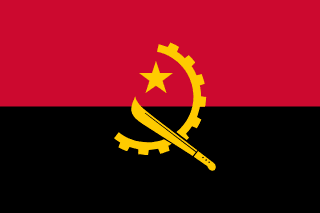
Flag of AngolaNational Flag

Geography & Borders

CongoCongoDR CongoDR CongoZambiaZambiaNamibiaNamibia

Introduction & Background

Angola (/æŋˈɡoʊlə/ⓘ; Template:IPA-pt; Template:Lang-kg, Template:IPA-kg), officially the Republic of Angola (Template:Lang-pt, Template:Lang-kg), is a country located on the west coast of central-southern Africa. It is the second-largest Lusophone (Portuguese-speaking) country in both total area and population (behind Brazil in both cases), and is the seventh-largest country in Africa. It is bordered by Namibia to the south, the Democratic Republic of the Congo to the north, Zambia to the east, and the Atlantic Ocean to the west. Angola has an exclave province, the province of Cabinda, that borders the Republic of the Congo and the Democratic Republic of the Congo. The capital and most populous city is Luanda.

Angola has been inhabited since the Paleolithic Age. Its formation as a nation-state originates from Portuguese colonisation, which initially began with coastal settlements and trading posts founded in the 16th century. In the 19th century, European settlers gradually began to establish themselves in the interior. The Portuguese colony that became Angola did not have its present borders until the early 20th century, owing to resistance by native groups such as the Cuamato, the Kwanyama and the Mbunda.

Overview
AttributeDetails
Official Name
Republic of Angola
Capital
Luanda
Continent
Africa
Region / Subregion
Africa / Middle Africa
Population
36,170,961
Area
1,246,700 km²
Languages
Portuguese
Currencies
Angolan kwanza (Kz) [AOA]
Cost of Living
25 / 100 (Low)
Price per Coffee
$1.25
Price per Meal
$5.00
Timezones
UTC+01:00 (WAT)
Bounding Box
Min: (17.93° S, 11.64° E)
Max: (4.44° S, 24.08° E)
Climate
Tropical / Warm
Terrain
narrow coastal plains, hills and mountains, high plains
GDP (Nominal)
$101.00 billion (2024)
GDP (PPP)
$383.35 billion (2024)
GDP Growth Rate
4.42% (2024)
Macroeconomic Overview
Angola has a semi-planned economy, in which central planning directs the economy with the participation of private enterprises. The economy remains heavily influenced by the effects of four decades of conflict in the last part of the 20th century, the war for independence from Portugal (1961–75) and the subsequent civil war (1975–2002). Poverty since 2002 is reduced over 50% and a third of the population relies on subsistence agriculture. Since 2002, when the 27-year civil war ended, government policy prioritized the repair and improvement of infrastructure and strengthening of political and social institutions. During the first decade of the 21st century, Angola's economy was one of the fastest-growing in the world, with reported annual average GDP growth of 11.1 percent from 2001 to 2010. High international oil prices and rising oil production contributed to strong economic growth, although with high inequality, at that time. 2022 trade surplus was $30 billion, compared to $48 billion in 2012.

Geography & Climate


  • Map Locations: Google Maps | OpenStreetMap

Minerals

No mineral species have their type localities (original discovery site) defined within Angola in the Wikidata database. Explore other galleries to view geographic and climate data.

Flora & Flowers

Angola is home to a diverse range of plant species. Explore some of the native plants and flowers found in Angola below:

Loading plant species...

Animals & Wildlife

Angola is home to a diverse range of animal species. Explore some of the native animals and wildlife found in Angola below:

Loading animal species...

Music Albums

Explore the top 30 most-played music albums in Angola, sourced from Apple Music charts:

Loading music charts…


← Back to Africa

Prev
Algeria
Next
Benin